Mattress Buying Guide
Reading the Layers: A Guide to Organic Mattress Construction
An organic label can tell you something about a mattress’s materials. It cannot, by itself, tell you how the bed is built—or how that construction will feel. To compare natural latex mattresses with confidence, look beyond the name on the tag and follow the layers from the cover inward.
Published November 10, 2026
A mattress is a small system of materials working together. The cover sets the first point of contact. Comfort layers soften and shape that contact. A support core carries the body and gives the bed its underlying character. In a latex mattress, the way those pieces are arranged can matter as much as the materials themselves.
That is why a broad description such as “organic mattress” is a beginning, not a complete buying guide. Two mattresses may use organic cotton, wool, and natural latex yet feel quite different. One may place a softer latex layer over a firmer core; another may use a single, uniformly firm slab. A removable topper can add still another layer—and another variable.
Understanding construction makes comparison more practical. It helps translate a materials list into questions about pressure relief, responsiveness, firmness, temperature, durability, and care. The aim is not to find a universally perfect arrangement. It is to understand what a mattress contains, what each layer is intended to do, and whether its overall design matches your preferences.
Start with the three main zones
Most mattress descriptions can be read in three broad zones: the cover, the comfort layers, and the support core. Some designs divide those zones into many components; others keep the construction simple. Either way, a clear account of the materials and their order is more useful than a string of adjectives.
The cover: the first layer you feel
The cover encloses the mattress and forms its sleeping surface. In organic and natural designs, it may use cotton, wool, or a blend. Its weave, padding, quilting, and tension can influence the initial sensation when you lie down. A quilted cover with wool, for example, can feel different from a smooth, tightly fitted cotton cover over latex.
Wool is often included for its ability to manage moisture and help moderate temperature. Cotton can provide a familiar, breathable fabric surface. These descriptions are useful, but they do not guarantee a particular sleep temperature or comfort outcome. Room conditions, sheets, personal preference, and the rest of the mattress all contribute.
Check whether the cover is removable, whether it is designed to be washed, and what care the manufacturer recommends. A zippered cover is not automatically machine-washable, and a removable cover may still require spot cleaning. If the cover cannot be washed, a suitable protector may help guard against spills and everyday soiling.
Comfort layers: the feel at the surface
Comfort layers sit below the cover and influence how the mattress responds to pressure. In a latex mattress, these layers may use latex with different firmness levels or thicknesses. A softer upper layer can create more cushioning, while a firmer layer beneath it can limit how deeply the body settles. The result depends on the complete arrangement, not one component in isolation.
Thickness matters, but it is not a shortcut to judging softness. A thin comfort layer over a firm core may feel quite different from a thicker layer with the same stated firmness. Likewise, two layers described as “medium” can vary between manufacturers. Firmness labels are not universal measurements, so construction details and a reliable comfort policy can help put the description in context.
The support core: the mattress’s foundation
The support core is the deeper section that provides the bed’s underlying stability. In an all-latex design, it is commonly made from a thicker latex layer or a sequence of latex layers. Its firmness and thickness affect how the mattress supports weight, how readily it responds to movement, and how much the comfort layers can compress.
A mattress with a firm core is not necessarily unyielding at the surface. Softer material above it can create a more cushioned first impression. Conversely, a mattress with a softer core may allow greater overall sink even if its top layer is not especially plush. When reading an organic mattress construction chart, pay attention to the whole stack rather than assuming the core tells the entire story.
Why layer order changes the feel
Materials do not operate in a vacuum. The same latex placed near the surface or deep in the mattress can contribute differently to the feel of the bed. A softer layer on top is engaged early as the body settles. A firmer layer beneath it can act as a transition, limiting deeper compression. Reverse the order, and the initial surface response may become firmer, even if the mattress contains the same ingredients.
Think of the construction as a sequence rather than a list. Ask which material you encounter first, what lies beneath it, and where the mattress becomes firmer. If a description simply lists “cotton, wool, and latex,” it leaves important questions unanswered: How thick is each latex layer? What is its firmness? Is the wool quilted into the cover or used as a separate topper? Is the core one piece or several?
Layer order can also affect how a mattress changes when you move. Latex is generally known for a responsive feel, returning more readily than slow-conforming foams after pressure shifts. The exact sensation will vary with the latex formulation, firmness, thickness, and surrounding materials. A layered design may make the surface feel buoyant, gently cushioned, or quite firm; “natural latex” alone does not settle the question.
For couples, the practical concern may be how much one person’s movement is felt by the other. For a combination sleeper, it may be how easily the bed accommodates changes in position. These are individual preferences, not guaranteed properties. Product descriptions that spell out the construction offer a better basis for questions than a generic comfort label.
Natural latex is not one construction
Natural latex is a material category, not a single mattress design. Some mattresses use latex in multiple layers; others combine it with wool and cotton in a more elaborate build. Latex may be described by its processing method, such as Dunlop or Talalay, but the process name does not tell you the finished mattress’s entire feel. Thickness, firmness, placement, and the other layers remain central.
In a layered latex mattress, separate pieces may allow the maker to combine different firmness levels. A firmer base with a softer upper layer is one common approach. A design may also use a single latex core, with comfort shaped by the cover and any added topper. Neither arrangement is automatically better. The relevant question is whether it suits the sleeper and whether the description is specific enough to evaluate.
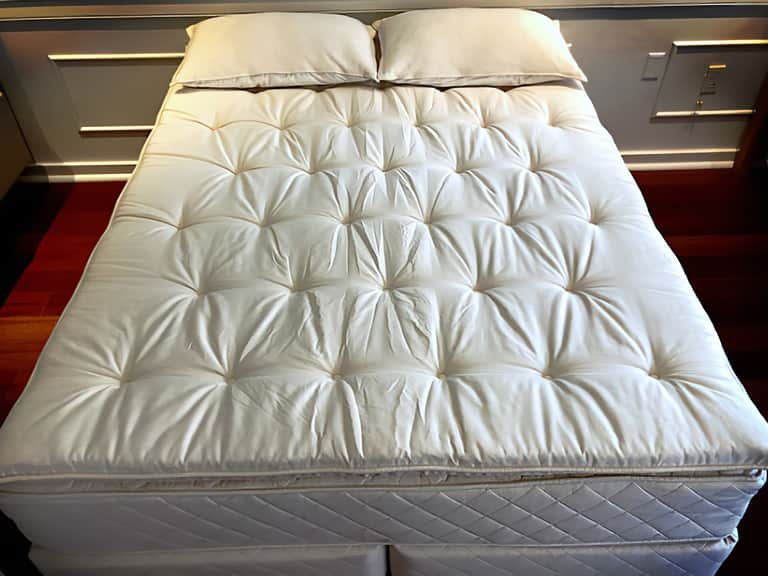
Some mattresses have a topper that is integrated into the overall construction; others are sold with a separate topper. That distinction affects both the feel and the maintenance plan. A separate topper may be easier to replace or adjust, but it can shift unless secured. An integrated topper may look and feel like part of the mattress, yet its cover and cleaning instructions may differ from those of the core mattress.
A construction example: the Hudson Luxe
The Naturally Organic Hudson Luxe Latex Mattress illustrates why it helps to read the layer details rather than relying on a category label. Its listed construction includes a five-inch firm organic Dunlop latex core and a three-inch medium organic Dunlop latex layer above it, enclosed in a cotton-and-wool casing. The mattress also has a separate topper described as containing organic wool and Dunlop latex, with a cotton cover. That arrangement provides a concrete example of a firmer core, a cushioning layer, and an additional surface component. It is one design among many, not a universal template for organic mattresses.
Certifications: useful, but read the scope
Certifications can help shoppers verify particular claims, but they should be read precisely. A certification may apply to a material, component, facility, or finished product; those are not always interchangeable. Look for the named standard, the materials it covers, and whether the mattress or only selected parts are certified. Avoid treating a broad phrase such as “certified organic” as a complete map of the construction.
For natural latex, some shoppers look for certification connected to organic latex. For cotton and wool, other standards may address the textile or agricultural supply chain. The relevant certification and its scope should be confirmed in the product’s current documentation. A logo on a product page is a prompt to investigate, not a substitute for checking exactly what it represents.
Certification also does not tell you whether a mattress will feel comfortable, suit your sleep position, or last a particular number of years. Those are separate questions. Materials credentials can inform a decision about sourcing and composition; firmness, support, pressure response, and fit require a different kind of comparison.
Match the construction to your preferences
Comfort is personal, and no sleep position produces a single correct mattress recipe. Still, considering how you sleep can help you decide which construction questions deserve attention. Side sleepers often pay close attention to cushioning at the shoulder and hip. Back sleepers may focus on balanced support and how the lower back feels. Stomach sleepers commonly consider whether the surface allows too much sinking. These are starting points for evaluation, not medical rules.
Body shape, weight distribution, mobility, and preference also affect how a mattress feels. A firmness rating that seems comfortable to one person may feel very different to another. If two people share the bed, each may experience the same layers differently. When possible, test a mattress in the position you normally sleep in and spend enough time to notice both surface softness and deeper support.
Pay attention to pressure points as well as the first impression. A mattress can feel inviting for a few minutes but become uncomfortable after longer use. Conversely, a surface that initially feels firmer than expected may settle into a comfortable, supportive feel. At home, a trial period can offer a more representative test than a quick showroom visit, provided you understand the terms and any conditions.
- For a more cushioned surface: Look for a clearly described comfort layer and check its thickness, material, and firmness—not just the word “plush.”
- For a firmer feel: Compare the firmness of the upper layers as well as the core; a firm base alone does not define the surface.
- For a responsive feel: Ask how the latex layers are arranged and whether the construction includes materials that change the surface response.
- For adjustability: Find out whether layers can be rearranged or replaced, and whether that option applies to the specific model and size.
- For a shared bed: Clarify whether each side can be configured independently, rather than assuming that a layered mattress offers split firmness.
A practical checklist for comparing mattresses
When you have several options open, use the same questions for each one. Consistent comparison makes it easier to identify what is known, what is missing, and where a seller’s wording needs clarification.
- What is in every layer? Note the cover fabric, any quilting or batting, the comfort materials, and the support core.
- What is the order from top to bottom? A materials list without sequence may hide meaningful differences.
- How thick is each component? Ask for measurements when they are not disclosed.
- What firmness is assigned to each latex layer? If the terms are relative rather than standardized, ask how the maker defines them.
- Is the topper separate or built in? Clarify whether it can be removed, replaced, or adjusted.
- What does each certification cover? Confirm whether it applies to the latex, textile, other component, or finished mattress.
- What are the care instructions? Check whether the cover can be removed, what cleaning is allowed, and whether turning or rotating is recommended.
- What are the trial and warranty terms? Read the conditions, duration, exclusions, and any fees rather than relying on a headline promise.
- Is the base compatible? Confirm support requirements, including any guidance for slats, platform frames, or adjustable bases.
These questions do not require technical expertise. They require clear answers. If a product description cannot say whether a layer is latex, wool, or cotton—or cannot explain where it sits in the mattress—treat the missing detail as a reason to seek clarification before comparing comfort claims.
Durability and maintenance are part of the design
Construction affects more than the first night’s feel. A mattress is used repeatedly under changing loads, and its layers may respond differently over time. Quality materials and sound construction matter, but no material makes a mattress immune to wear. How long a bed remains comfortable depends on its design, use, care, and the sleeper’s own expectations.
Read the warranty carefully. A warranty generally addresses specified defects under stated conditions; it is not necessarily a promise that comfort will remain unchanged. Pay attention to sagging thresholds, the required foundation, care instructions, and whether a removable topper is covered on the same terms as the core. Keep the purchase documentation and follow the maker’s maintenance directions.
A protector can help limit stains and spills, but its material may alter the surface feel. A thick or tightly fitted protector may affect how the comfort layers are experienced; a lighter option may preserve more of the mattress’s original sensation. Consider protection needs alongside the mattress’s construction, and check that the protector fits the mattress depth.
Do not assume a mattress should be flipped. Some layered designs have a defined top and bottom, and reversing them may place the support components in the wrong order. Rotation may be permitted or recommended for certain models, but instructions differ. The manufacturer’s guidance is the authority for that specific construction.
Common misconceptions about organic mattress construction
“Organic” means every component is identical in every mattress.
It does not. The term points toward materials and sourcing claims, but construction can vary widely: different latex thicknesses, firmnesses, covers, quilting, and topper arrangements all change the finished bed.
More layers automatically mean more comfort.
More layers may allow a maker to create a particular feel, but complexity is not a measure of suitability. A simpler design can be a better fit for one sleeper, while another may value distinct comfort and support zones. The purpose of each layer matters more than the count.
A natural material guarantees a cool night.
Breathability and moisture management can be relevant design considerations, but no material can promise a particular temperature for every person. Climate, bedding, room conditions, and individual physiology all play a role.
A firmness label makes mattresses easy to compare.
Firmness descriptions can be useful within one maker’s range, but they are not necessarily standardized across brands. Compare the stated layer construction and use trial terms or in-person testing to add context.
A certification tells you whether a mattress is comfortable.
Certifications address particular material or production criteria. They do not determine personal comfort, alignment, or whether a given layer arrangement suits your body and sleep habits.
The clearest mattress is the one you can understand
Buying an organic mattress need not mean decoding a wall of unfamiliar terminology. Start with the basic architecture: cover, comfort layers, support core. Then follow the materials in order, noting thickness and firmness wherever they are provided. Ask how a topper fits into the design and what a certification actually covers. Finally, consider the feel you prefer and the terms that will let you test that preference in real life.
The phrase “natural latex mattress” describes a starting point, not a conclusion. A useful comparison explains how the latex is used, what supports it, what sits above it, and how the mattress is meant to be cared for. Once the layers are visible on paper, the choice becomes less about a label and more about a construction you can evaluate.
That is the central lesson of mattress literacy: materials matter, but so does their arrangement. The details are not fine print. They are the blueprint of the bed.
Frequently asked questions
What are the main layers in an organic latex mattress?
Most descriptions can be understood as a cover, one or more comfort layers, and a support core. Some mattresses also include quilting, wool, or a separate topper. The exact materials and order vary by design.
Does more latex mean a softer mattress?
Not necessarily. Feel depends on the latex’s firmness, thickness, and position in the mattress, along with the other layers. A thicker latex layer can be firm or soft depending on its formulation and design.
What should I compare when buying an organic mattress?
Compare the materials and their order, layer thicknesses, firmness descriptions, cover construction, certification scope, care instructions, and trial and warranty terms. These details provide a fuller picture than an organic label alone.
Is a mattress topper part of the mattress construction?
It depends on the design. Some toppers are integrated or included as a distinct component; others are separate accessories. Ask whether the topper can be removed and how its care and warranty are handled.